

Principles for Adapting Activities in Recreation Programs and Settings

Tip Ray, M.Ed., CTRS
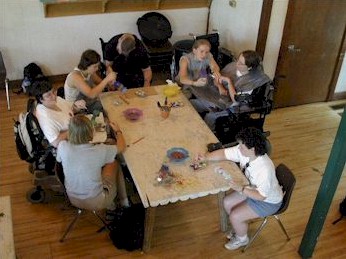
We know through research, anecdotal evidence, and personal experience that people with disabilities benefit greatly when they participate in community recreation programs and settings. Like their peers who may not have disabilities, they learn how to make choices, take turns, Photo of a group of  people with and without disabilities working around a table on crafts.follow directions, and share and perform as a team. They learn the same leisure skills and behaviors-although sometimes at a different pace and in a slightly different way. From their peers, they gain respect, are appreciated, are accepted, and, oftentimes, become friends. They learn how to play and have fun in the same activities and places where their peers hangout, and play and have fun.

We also know, through all the same ways, that people without disabilities benefit from these interactions. Stereotypes are eliminated, as people's awareness is heightened and attitudes change. When this happens in a fun place - like a community recreation center or a neighborhood ball field -new, more accepting, and, consequently, more accommodating attitudes and behaviors find their way into other areas of everyday life - at school, in the workplace, and when a chance meeting happens at the grocery or in the neighborhood.

Finally, we know that community recreation agencies will become more open and inclusive of people with disabilities when they can see that ALL participants benefit from participating in leisure activities and settings. While many state and federal laws mandate equal access to recreation programs and environments, there is still reluctance and, in many instances, resistance to institutionalizing fully inclusive practices. Fear of the unknown, past practices, and uncertainty about "how" to include people with disabilities into recreation environments are several of the more prevalent obstacles. With the support and involvement of advocates of inclusion - parents, teachers, advocacy agency staff, potential participants both with and without disabilities, as well as concerned and interested recreation professionals, themselves - obstacles change to opportunities. Attitudes and practices shift dramatically. Inclusive programs and settings become the norm.

Including people with disabilities in community recreation is both a goal and a process. The final outcome of the process is the goal - i.e., people are, in fact, active and accepted participants in community leisure experiences alongside their nondisabled peers. There are many elements of the process that community recreation providers should consider in their efforts to include people with disabilities in program activities and settings. In fact, much has been written about this topic in the past 20-plus years (see References and Resources section). Suffice it to say that inclusion doesn't just magically happen. It takes committed people, who apply certain principles and systematic planning approaches to make certain that at the end of the day, when the recreation center's light go out, everyone who has come through the door has had a successful and enjoyable leisure experience.

Let's believe, for now, that the recreation agency has provided appropriate outreach to recruit participants with disabilities into their program offerings, e.g., a summer day camp, craft class, or sports league. Registrations start to come in and, among them are several from persons who have disabilities. In the past, these individuals would have been referred to special or adaptive recreation programs where specially trained staff would know "what to do." Times are changing and the new reality is that all program offerings must be open and accessible. Assumptions are made that these individuals require a full time aide to accompany and "help" them. Assumptions are made that costly specialized equipment and other scarce resources must be provided to accommodate these persons. Assumptions are made about the value and worthiness of having this individual in the program - What benefits are there for him or her? How disruptive will they be to other participants? How much time will it take from staff (i.e., away from the program and other participants)? And, so on and so forth. Well, we all know what happens when we "assume"!

A complete registration form would ask if the prospective participant has a need for any special accommodations to be involved in the activity. A common approach is for recreation staff to provide a follow-up phone call to discuss these needs more specifically. Prior to this call, staff should have a thorough knowledge of how the activity will be implemented so that they can provide this overview to the participant (or parent, caregiver, or other advocate), enabling this person to detail if and when they may or may not need or desire assistance and what that assistance may look like. (An excellent, easy to use pre-program planning process to apply here is the Recreation Inventory for Inclusive Participation (RIIP) described in Schleien, Ray, Green, 1997.) The recreation staff may also choose to invite the prospective participant to the recreation setting where the activity will take place for a tour and meeting to discuss necessary accommodations. The individual, or support person, should feel free to take the initiative and make this suggestion, as well. Face-to-face meetings go a long way in changing attitudes and dispelling stereotypes. However, a critical question remains to be answered:

"If we do not want to get caught making inappropriate assumptions when making decisions about the types and need for specific program and activity adaptations, what principles can help guide us?"

Consider that adaptations are normal strategies we all create to enhance our participation in the many activities of our daily lives, including our leisure lives - e.g., putting on sunglasses, hat, and sun screen while at the beach; carrying a water bottle to quench our thirst; wearing headphones while listening to our portable CD player; changing into exercise clothes before our jog. Adapting and modifying our approach to our leisure life has become instinctual, intuitive, and, frankly, normal. However, because of our uncertainty about what adaptations work or don't for people with disabilities, we just need to apply our thinking process a little more thoughtfully and systematically. Ironically, you'll find that more often than not the adaptations you design will look familiar to those you may have implemented for yourself and others at some other time! When considering what adaptations to make, if any, there are several categories one might consider.

Photo of a child sitting atop a horse with pads to help position her in the saddle. Examples include: Sport specific vs. standard wheelchairs; shoe orthotics for runners; Braille and audio cassettes; foam vs. solid balls and Frisbee disks; batting tee's; paved vs. natural surface trails; protective eyewear/goggles vs. regular glasses; fat crayons vs. regular crayons; closed-captioning; accessible play structures; soap bar vs. wood for carving; using an electric cart vs. walking a golf course

Examples include: Allow 2-handed basketball dribble; allow holding volleyball before throwing it over the net; lowering the net; allow double bounce for tennis, ping-pong; allow alternate ID - not driver's license - as collateral to check out leisure materials; having a "no strikeout" rule for baseball; move closer to a target (archery, horseshoes); having a pusher to run the bases

Examples include: Dress in exercise clothing at home vs. locker room; come earlier to class; put food item in oven before turning oven on; perform activity after observing others; staff comes out from behind the high service counter to talk with and register prospective participant; staff calls/meets with prospective participant prior to program to assess possible accommodations; uses a volunteer advocate or older sibling to assist with participation; gets credit for partial participation (i.e., doing what they can); cooperative groups take the place of individual performance in art class; implementing a school developed behavior modification program

Examples include: Upgrade/retrofit facilities (bathrooms, doorways, ramps, play structures) to enhance accessibility; relocate class to an accessible building; trim overhanging and intruding branches on a hiking trail; installation of an adjustable basketball backboard; a unisex changing room is designated

The following represents tried and true principles when considering the need for and types of adaptations necessary to assure that individuals with disabilities are given every opportunity to have equal access to and benefit from their participation community recreation activities.(Schelein, et al., 1995; Schleien, Ray, Green, 1997; Wehman & Schleien, 1981) Addressing each will make certain that recreation program planners and activity leaders are addressing the real needs of participants with disabilities. It's easy enough to do when one cares about the process and the outcome!

Principle #1: Adapt only when necessary

Many people with disabilities lead very independent lives and require very few additional accommodations and supports to participate in leisure activities and environments beyond those typically employed by most. Take the opportunity to review with prospective participants the nature of the activity and allow them to tell you "I can do this" or "I can't do that-here's what I need to assist me." Use this as a basis for discussing specific adaptations and other possible accommodations.

Additionally, some providers fail to provide modified environments as required by state and federal accessibility laws, thereby limiting the choices and opportunities for people with disabilities. They never see people with disability in the recreation settings, thus assuming (there's that word again!) they aren't interested in participating. Consider this corollary:
Adapt when needed to increase a person's participation, success, and enjoyment.
Here are some examples:

Principle #2: Adapt on an individual basis

Photo of a woman helping a young man balance as he walks a rope

Be certain that adaptations, which are considered and designed for an activity, are, in fact, relevant for a particular participant. Oftentimes, recreation programs purchase modified or specialized equipment (e.g., beeping balls for persons who are blind) or hire extra staff in anticipation and assumption of its need by prospective participants with disabilities. It's good to be prepared. However, these can be costly additions and, as such, programmers want to justify the expense by assuring its use, whether it's totally necessary or not. In addition, stereotypes and attitudes about certain types of disabilities create a mindset in programmers that certain adaptations are always needed. Conversely, make certain that activity adaptations and specialized equipment or acceptable alternatives is available when needed. Foam Frisbees, batting tees, and activity aides may be acceptable substitutes, which allow a person with a disability an opportunity to play alongside his peers. Make them available, when needed. For example:

Principle #3: View any adaptations as temporary.

Consider adaptations as transitional until the person can learn the skills and behaviors to participate in the standard or typical way. Some modifications, like use of a wheelchair, dog assistant, or prosthetic device, may always be necessary. However, prevent people with disabilities (or the recreation staff!) from becoming unnecessarily dependent on these adaptations, thereby further limiting future options and opportunities for this person to enjoy these activities in more inclusive settings. For example:

Principle #4: Adapt for Congruence

Photo of a group involved in craft work at an outdoor table.

Any adaptations or modifications should make sense, not only for the person using them, but to others observing their use. Unique or exaggerated adaptations and modifications, i.e., those which may not be usually seen or experienced by nondisabled participants, may have an unintended consequence of further limiting the inclusion and acceptance of the person with a disability. They may just seem too "weird" or more importantly to youngsters, unfair. In fact, they help reinforce stereotypes about disability and underscore how different "these people" are. For example:

Principle #5 - Adapt for Availability

Adaptive equipment, materials and support provided in one recreation environment may not be readily available in another comparable environment. Consideration should be given to assuring that materials and services (e.g., activity aides) purchased aren't so specialized that the participant using these adaptations don't have their options and opportunities limited to using them in only one setting.

In addition, several companies sell specialized equipment especially marketed to the disability community. Unfortunately, because of the specialization in both types of material, as well as the target customer, these products are quite expensive and difficult to obtain. The average person may not be able to purchase these materials.

Program planners should keep these issues in mind when suggesting and designing adaptations. If children learn how to play a game or sport using modified equipment at the neighborhood center, parents should be able to purchase these same games and sports materials at local discount retailers, plus have the know-how to modify them, if necessary. People should know that if they decide to take an art class at community education sites at different locations across the city, adaptive materials and support would be available. It does no good for people to become dependent on one location to meet all their leisure and recreation needs. After all, the true essence of the leisure experience is to be able to choose confidently among many alternatives. People want to know that wherever they go and whatever they choose to do, they will have the support they need to be included and successful in this experience. For example:

Photo of a young man who has both legs amputated climbing up a climbing wall. Adapting and modifying recreation settings and programs is a typical and viable approach for addressing the unique leisure needs and situations of all prospective recreation participants - especially people who have disabilities. Because, in the past, we have relied predominately on specialized staff to address and meet the leisure needs of people with disabilities, there is uncertainty about how to create programs that assist people with disabilities to have a successful, enjoyable, and truly inclusive leisure experience. Changing laws, new technology and increased awareness require recreation providers to be more inclusive in attitude and actions. Recreation programmers are encouraged to continue to approach the task of addressing the leisure needs of people with disabilities as they would with any other participant - professionally, patiently and with an open and imaginative mind. The goal, after all, is the same - the provision of quality recreation programs and environments for all members of the community - including people with disabilities. Best wishes and good luck!

Tip Ray is an author, practitioner, and consultant focusing on inclusive and therapeutic recreation the past 20+ years. He is active in outdoor pursuits - canoeing, backpacking, bird watching, jogging, cross- country skiing. He is a certified official for the sport of biathlon and will work at the 2002 Salt Lake Winter Olympic Games. You can contact Tip at: tipr@aol.com.

The information provided here is offered as a service only. The National Center on Physical Activity and Disability, University of Illinois at Chicago, the National Center on Accessibility, and the Rehabilitation Institute of Chicago do not formally recommend or endorse the equipment listed. As with any products or services, consumers should investigate and determine on their own which equipment best fits their needs and budget.

National Center on Physical Activity and Disability
http://www.ncpad.org
ncpad@uic.edu
(800) 900-8086 (voice and TTY)
(312) 355-4058 (facsimile)

  1. Rynders, J. & Schelein, S. (1991). Together Successfully: Creating Recreational and Educational Programs that Integrate People with and without Disabilities. Arlington, TX: ARC-US.
  2. Schelein, S., McAvoy, L., Lais, G., & Rynders, J. (1993). Integrated Outdoor Education and Adventure Programs. Champaign, IL: Sagamore Publishing.
  3. Schleien SJ. (1995). Lifelong leisure skills and lifestyles for persons with developmental disabilities. Baltimore, Maryland: Paul H. Brookes Publishing Company.
  4. Schleien, S.J., Ray, M.T., Green, F.P. (1997). Community Recreation and People with Disabilities: Strategies for Inclusion. Baltimore, Maryland: Paul H. Brookes Publishing Company.
  5. Wehman P, Schleien SJ. (1981). Leisure programs for handicapped persons. Austin, Texas: Pro-Ed.


This fact sheet was last updated on 12-20-2005.

Add a Fact Sheet Section

Update this Fact Sheet
(edit sheet name, edit organizations, etc.)
"The information provided here is offered as a service only. The National Center on Physical Activity and Disability, University of Illinois at Chicago, the National Center on Accessibility, and the Rehabilitation Institute of Chicago do not formally recommend or endorse the equipment listed. As with any products or services, consumers should investigate and determine on their own which equipment best fits their needs and budget."
Update Disclaimer