
Attitudes
The greatest discovery of my generation is that a human being can alter his life by altering his attitudes of mind.
William James
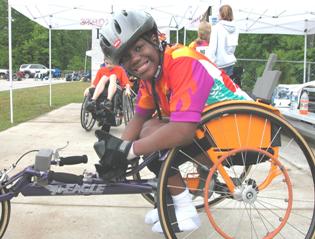
As parents search for ways to help create an active lifestyle for their child with a physical disability, it is imperative to keep in mind that parental attitudes relative to a child’s involvement in sport, as well as their overall potential, are key to the child’s success.
The attitudes that parents have must not only be positive, supportive and dynamic, but they must also be contagious, in order to be absorbed by the child, his or her friends, peers, and the extended family. When everyone adopts a positive attitude, an environment is created and opportunities are taken, limits are removed, and potential is increased.
The first step in creating an environment where your child can flourish is realizing that your child, regardless of ability, is capable and worthy of all the same opportunities that are offered to children without disabilities. Your child can have a happy and active lifestyle that meets individual needs and interests. Once this attitude is achieved, it must be placed into action.
Communication
The most important thing in communication is to hear what isn't being said.
Peter Drucker
A key component in facilitating healthy, active lifestyle habits for your child is to communicate to define their interests. While there may be times where you may need to gently encourage your child to try a new activity, sport, or event, it is imperative to know where his or her interests lie and provide or seek out opportunities and challenges that meet those interests.
By creating open lines of communication, you will learn:- the physical activity interests of your child
- whether your child is interested in recreational or competitive opportunities
- if your child is more interested in individual or team endeavors, or both
- what goals your child has (or doesn’t have) for his or her fitness
- how you can help your child achieve his or her goals
Selecting Appropriate Activities
Happiness is not achieved by the conscious pursuit of happiness; it is generally the by-product of other activities.
Aldous Huxley
Once you have created a positive and supportive environment that will facilitate opportunities for your child to be active and have learned the interests of your child, you can then work with your child to select the activities in which he or she will participate. The number-one factor in choosing appropriate activities should be FUN! Any activity chosen for your child, either by you, your child, or as a group, should offer varying degrees of fun. The primary reason that children participate in sports is fun, and the key reason they quit is a lack of fun. Community-based programs that offer activities for children with disabilities can provide suggestions to help both you and your child select the most appropriate activities for your child’s interests and goals.
A national, community-based program that offers opportunities for children with physical disabilities is BlazeSports America. With 49 clubs and 10 affiliates in 2006, BlazeSports can help you find a local program that will fit your needs. In addition, NCPAD offers a programs database that lists physical activity-related programs throughout the nation that offer opportunities for people with disabilities.
Then the question becomes, "How do I ensure that an activity that my child is interested in will be fun?" There are no guarantees, but listed are some guidelines that you can follow to help make each experience the best that it can be. To be successful in helping your child create a healthy lifestyle, activities must be selected that will help your child achieve feelings of:- belonging/acceptance
- success
- accomplishment
- growth
- competence
Goal Setting
In absence of clearly defined goals, we become strangely loyal to performing daily acts of trivia.
Unknown
Goal setting can be done before and after selecting appropriate activities. Goal-setting can be used before selecting activities in order to help determine what activities may best serve the health, fitness, athletic, recreational, and social goals of the family and the child. Goals to consider prior to selecting activities include:
- making new friends
- developing specific motor skills
- learning independence
- participating individually (recreationally or competitively)
- participating on a team (recreationally or competitively)
- increasing aerobic or anaerobic activity
- interacting with peers who may or may not have a disability
After selecting an activity, you and your child need to decide specific outcomes and goals that you want to achieve as a result of participating in that activity. These outcomes and goals should be measurable and achievable. Each goal should also be written down and put in a place that is typically visible, such as the refrigerator or bedroom door. Additionally, once a goal is achieved, a new goal should be set.
As an example, let’s say that the appropriate activity that was chosen was recreational basketball. This can apply to either ambulatory or wheelchair basketball. Assuming that the child is 10 years old, somewhat active, enjoys basketball, but has never played it, here are some goals that may be established for this activity:- learn the rules of the game
- make two new friends
- write down what you enjoyed most during each practice/session
- write down one thing that you learned during each practice/session
- lose 5 pounds by being more active
- successfully perform a lay-up
Healthy Diet
Water is the most neglected nutrient in your diet but one of the most vital.
Kelly Barton
Part of facilitating a healthy lifestyle for your child is educating him or her about what constitutes a healthy diet. By teaching your child the basics of healthy, balanced eating, and putting those basics into practice, you will help him or her create a healthy eating lifestyle that can last a lifetime.
You should encourage your child to eat a healthy and balanced diet and make the necessary changes to his or her eating habits to facilitate the change. For example, items that should be very limited in a healthy diet include processed sugars such as candy, chocolate, and soda. Items that should take a prominent role include fruits, vegetables, and low-fat proteins. One key to a healthy diet is variety and moderation within the recommendations of the food pyramid.
Be a role model for your children. You may want to tell them, "Do what I say, not what I do," but your actions speak louder than words. Use this opportunity to change your own eating habits and create a healthier you along with your child.
A good start to healthy eating is learning the basics of the Food Guide Pyramid. An electronic copy of the pyramid can be downloaded from NCPAD at http://www.ncpad.org/nutrition/fact_sheet.php?sheet=93.
By using the Food Guide Pyramid, you can help your child learn about the nutrients a body needs to be healthy. The body requires the following nutrients: carbohydrates, protein, fat (lipids), vitamins, minerals, and water. You will be able to teach them what foods offer what nutrients and what portions they should consume for a healthy, balanced diet. The pyramid can also be used to teach areas of focus for menu planning. For example, help your child to include all levels or areas of the pyramid when eating healthy. Keep in mind that the "oils" area of the pyramid should be a small focus and ideally not used at every meal.
For information specific to your age, sex, and physical activity level, go to http://www.mypyramid.gov/ to obtain a personalized Food Guide Pyramid.
Facilitating Independence and Self-Sufficiency
Great ability develops and reveals itself increasingly with every new assignment.
Baltasar Gracian
We have discussed attitudes, communication, selecting appropriate activities, goal setting, and a healthy diet. The information presented may help you assist your child to become as independent and self-sufficient as possible. Utilizing the following recommendations may help create an environment that fosters healthy activity and independence.
Consider the following when helping your child strive towards his or her maximum level of independence and self-sufficiency. FAILURE is a necessary component of growth. Mistakes are opportunities to learn, and failure is an opportunity to try again and succeed by making changes in the process of attaining goals. Do not be afraid to let your child fail. Evaluate how you and your child deal with failure and if the common approach is constructive with respect to growth and independence.
While you must allow your child to fail every now and then, you must also be there to SUPPORT his or her ability to find a way to succeed. Always be positive and supportive and do not set limits on his or her potential. Children have an uncanny ability to live up to expectations, no matter how high or low they are. If you convey your realistic expectations in a supportive manner, you will see your child achieve great success and independence.
You may need to be PERSISTENT in order to initially involve your child in a physical activity. If you have communicated well with your child and know his or her interests, fear not. Be persistent in providing him or her with opportunities to be active, even if your child is not enthusiastic initially.
Do your best to make your home, your child’s school environment, and places your child frequents as barrier-free as possible. Often times the disabling factor is not a person’s ability, but the inadequate ENVIRONMENT in which he or she must operate. The less restrictions that your child faces at home and in public, the more independent and self-sufficient he or she will become. These changes include not just eliminating physical barriers, but mental barriers as well.
Finding an Adapted Sports Program
Many resources exist for a parent to locate an adapted sports program for their child. To find a local program, a parent may contact the YMCA, park district, adapted P.E. teachers in the school district, or the National Center on Physical Activity and Disability Program Directory/Database. People who reside in Illinois may also contact their local Special Recreation Association (SRA), an extension of community park districts. Listings of Illinois SRAs can be found at http://www.illinoisparksandrecreation.com/links/index.htm.
National Center on Physical Activity and Disability (NCPAD)
1640 W. Roosevelt Road, Suite 711
Chicago, IL 60608
Phone: 800-900-8086
Fax: 312-355-4058
Email: ncpad@uic.edu
URL: www.ncpad.org
BlazeSports America (U.S. Disabled Athletes Fund)
280 Interstate North Circle Suite 450
Atlanta, Georgia 30339
Phone 1: 770-850-8199
Fax: 770-850-8179
Email: blazesports@blazesports.com
URL: http://www.blazesports.com
Disabled Sports USA (DSUSA)
451 Hungerford Dr., Suite 100
Rockville, Maryland 20850
Phone 1: 301-217-0960
TTY: 301-217-0963
Fax: 301-217-0968
Email: dsusa@dsusa.org
URL: http://www.dsusa.org/
National Recreation and Parks Association
22377 Belmont Ridge Road
Ashburn, Virginia 20148-4501
Phone 1: 703-858-0784
Fax: 703-858-0794
Email: membership@nrpa.org
URL: http://www.nrpa.org/
National Disability Sports Alliance (NDSA)
25 West Independence Way
Kingston, Rhode Island 02882
Phone 1: (401) 792-7130
Fax: (401) 792-7132
Email: info@ndsaonline.org
http://www.ndsaonline.org
National Sports Center for the Disabled
P.O. Box 1290
Winter Park, Colorado 80482
Phone 1: 970-726-1540
Phone 2: 303-316-1540
Email: info@nscd.org
URL: www.nscd.org/
National Ability Center
P.O. Box 682799
Park City, Utah 84068
Phone 1: 435-649-3991
TTY: 435-649-3991
Fax: 435-658-3992
Email: info@nac1985.org
URL: http://www.nac1985.org/
Illinois Park and Recreation Association
106 North Schmale Road
Carol Stream, IL 60188
Note
This document was developed through a collaborative effort between NCPAD and BlazeSports.
This fact sheet was last updated on 10-30-2006.

The information provided in this website was supported by Grant/Cooperative Agreement Number U59/CCU522742-02 from the Centers for Disease
Control and Prevention (CDC).